
Superstition in Indian society does not begin with harm. Instead, it usually starts with fear—fear of the unknown, fear of loss, and fear of uncertainty. As a result, uncertainty seeks comfort, and over time, that comfort evolves into a belief.
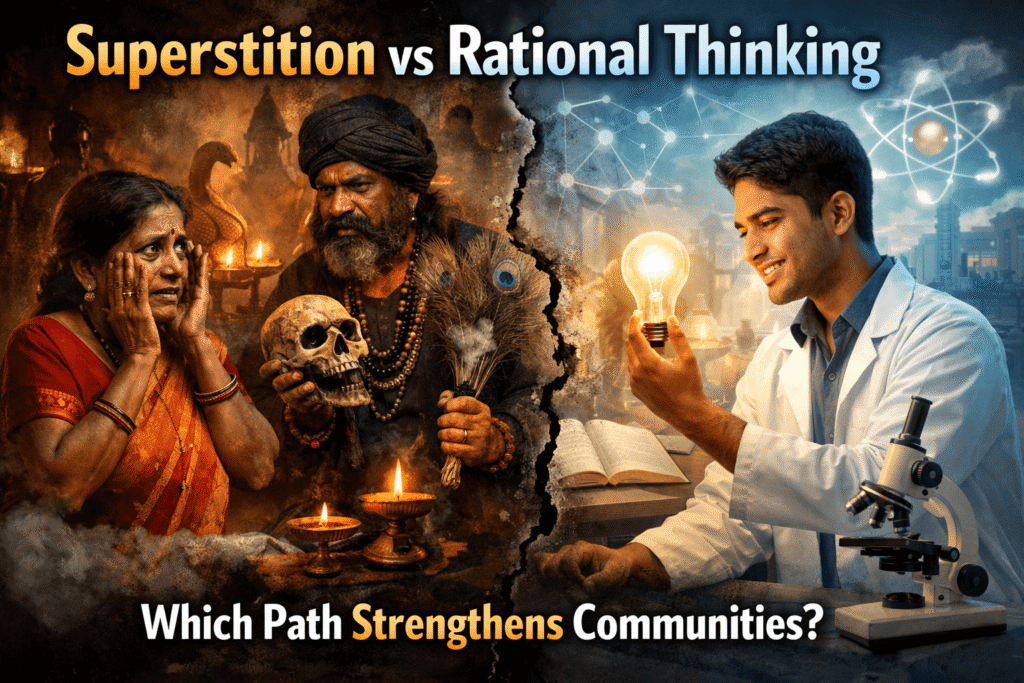
Fear of the unknown creates uncertainty.
As a result, uncertainty looks for comfort.
Over time, that comfort slowly turns into belief.
When belief is never questioned, superstition takes root.
In many societies, including India, superstition still influences decisions related to health, safety, education, and justice. While traditions can preserve cultural identity, unchecked superstition weakens communities and delays progress.
What Is Superstition in Indian Society?
Superstition is often confused with faith.
However, the two are not the same.
Faith can coexist with understanding.
Superstition, on the other hand, is rooted in fear rather than evidence.
It assumes that unseen forces control events without logical explanation.
As a result, superstition becomes rigid and unquestionable.
Common signs of superstition include:
- Fear-driven decisions
- Blind acceptance of authority
- Resistance to questioning
- Dependence on intermediaries
When such beliefs dominate, rational thinking is pushed aside.
How Superstition in Indian Society Weakens Communities
In many regions, superstition in Indian society continues to influence decisions related to health, education, and personal safety.
1. It Replaces Medical Care With Fear
In many situations, superstition discourages people from seeking medical help.
Instead of consulting doctors, illnesses are blamed on curses, spirits, or divine punishment.
Consequently, this leads to:
- Delayed treatment
- Worsening health conditions
- Preventable loss of life
Therefore, fear begins to overpower reason.
2. It Enables Exploitation
Where fear exists, exploitation often follows.
Many fake healers, godmen, and self-proclaimed spiritual guides use superstition to gain money, influence, and control. Because communities do not question these claims, they become easy targets.
As a result:
- Vulnerable people suffer the most
- Rational voices are silenced
- Dependency replaces independence
Clearly, empowerment cannot exist where fear governs choices.
3. It Suppresses Critical Thinking
Superstition actively discourages questions.
Children are often taught to obey without understanding.
For example, they hear:
- “Do not ask why.”
- “This is how it has always been.”
- “Questioning is disrespectful.”
Consequently, curiosity fades.
Over time, innovation slows.
Eventually, communities remain stagnant.
Rational Thinking as a Solution to Superstition in Indian Society
Rational thinking does not destroy culture.
Instead, it strengthens it.
By encouraging curiosity, rational thinking allows people to:
- Ask meaningful questions
- Seek evidence
- Understand cause and effect
- Make informed decisions
As a result, communities become more resilient and adaptable.
How Rational Thinking Empowers Communities
1. It Reduces Fear
When people understand why events occur, fear gradually weakens.
In other words, knowledge replaces anxiety.
Because of this, informed communities respond calmly rather than emotionally.
2. It Promotes Responsibility
Rational thinking shifts focus from supernatural blame to real-world causes.
Therefore, individuals and communities take responsibility for improvement.
As a result, planning increases and dependency decreases.
3. It Protects Human Dignity
Every individual deserves safety, respect, and informed choice.
Rational awareness ensures that no one is harmed or isolated due to irrational beliefs.
Consequently, compassion is guided by understanding rather than fear.
Superstition vs Rational Community Empowerment
The difference between the two is clear.
| Superstition | Rational Empowerment |
|---|---|
| Fear-based thinking | Knowledge-based thinking |
| Blind belief | Informed belief |
| Exploitation | Awareness |
| Silence | Dialogue |
| Dependence | Self-reliance |
Therefore, this transition is essential for long-term progress.
ASRRA’s Role in Addressing Superstition
ASRRA (Association Supernatural Research and Reform Advocacy) challenges superstition without attacking faith.
Instead, its work focuses on:
- Scientific investigation
- Public awareness
- Compassionate dialogue
- Protection against exploitation
Ultimately, the goal is not to control belief, but to encourage people to think before believing.
Why Superstition in Indian Society Still Matters Today
India’s diversity is a powerful strength.
However, unchecked superstition continues to harm public health, education, and social harmony.
For this reason, empowering communities through rational thinking is essential.
This is exactly why rational community empowerment in India is a practical necessity, not just an idea.
👉 Learn more about this approach through rational community empowerment in India.
(Link to pillar article.)
Conclusion: Awareness Is the First Step to Freedom
Superstition survives where fear is protected.
However, rational thinking grows where awareness is encouraged.
Communities do not lose identity by questioning.
Instead, they gain strength.
Ultimately, empowerment begins when fear is replaced with understanding.
Superstition in Indian society refers to fear-based beliefs that are followed without evidence or rational understanding. These beliefs often influence decisions related to health, safety, education, and social behavior, sometimes causing harm instead of protection.
Superstition weakens communities by promoting fear, discouraging critical thinking, and enabling exploitation. When people avoid questioning beliefs, they may delay medical treatment, depend on false authorities, and lose the ability to make informed decisions.
No, rational thinking is not against faith or tradition. It helps people understand the difference between belief and fear. Rational awareness allows individuals to practice faith with clarity while preventing harm caused by blind or exploitative beliefs.
Rational thinking empowers communities by reducing fear, encouraging responsibility, and promoting informed choices. Communities that think rationally are better equipped to handle misinformation, social challenges, and crises without panic or dependency.
ASRRA approaches superstition through scientific investigation, public awareness, and compassionate dialogue. The focus is on encouraging people to think before believing, rather than telling them what to believe or disrespecting cultural values.
Superstition in Indian society still matters because it affects public health, education, and social harmony. Addressing it through awareness and rational thinking helps protect human dignity and strengthens communities for the future.