
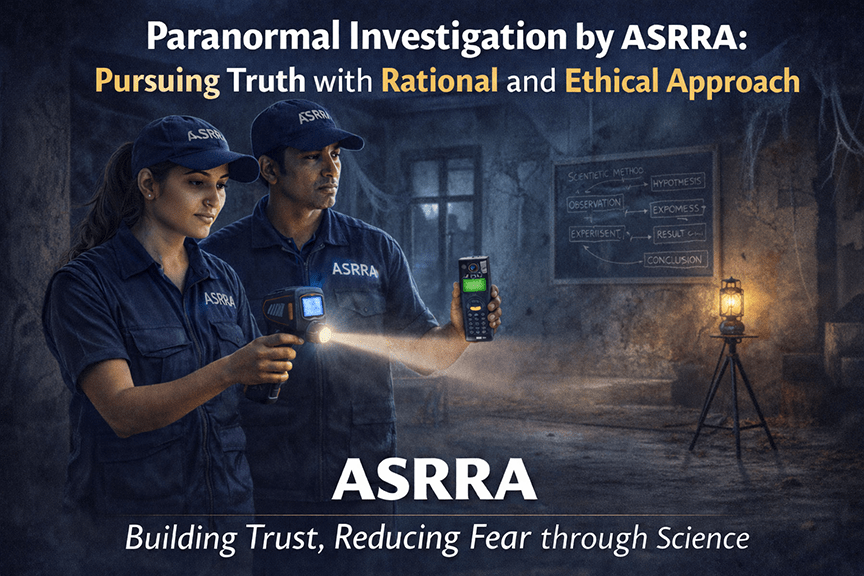
Paranormal investigation is often misunderstood. However, at ASRRA (Association for Supernatural Research and Reform Advocacy), we approach it differently. Rather than relying on sensationalism or fear, our investigations are rooted in rational thinking, scientific observation, and social responsibility. Therefore, communities gain understanding, not panic.
Indeed, understanding is the first step toward reducing fear, and our mission is to empower people with knowledge—not superstition.
Why a Rational Approach Matters
Many people encounter unexplained events. Nevertheless, without guidance, these experiences often cause fear, stress, or even exploitation.
Consequently, ASRRA focuses on:
- Logical examination of claims
- Scientific observation of evidence
- Psychological understanding of witnesses
- Community reassurance through transparency
As a result, uncertainty is replaced by clarity, and communities feel supported rather than scared.
Evidence-Focused Investigations
Unlike commercial paranormal groups that prioritize entertainment, ASRRA prioritizes accuracy and evidence.
First, every investigation begins with careful observation and documentation. Then, investigators avoid assumptions, examining environmental, psychological, and social factors before concluding.
Thus, communities can trust both the process and the results, which naturally reinforces confidence rather than fear.
Scientific Temper at the Core
Scientific temper guides all our investigations. Instead of dismissing experiences outright, ASRRA evaluates them responsibly.
Therefore:
- Superstition weakens
- Awareness strengthens
- Rational community empowerment becomes possible
Moreover, this careful balance between inquiry and empathy builds long-term trust with society.
Building Community Trust
Fear often isolates people. However, ASRRA’s investigations reconnect communities with understanding.
- Consequently, families feel heard and respected.
- Meanwhile, communities feel supported.
- Thus, panic is prevented.
Through these methods, trust grows naturally, reinforcing ASRRA’s credibility and reliability.
Ethical Boundaries We Follow
ASRRA investigators adhere to strict ethical guidelines. Specifically:
- No exaggeration of findings
- No rituals or superstitions promoted
- No financial pressure applied
- No beliefs imposed
As a result, our work remains credible, reliable, and fully focused on awareness.
Paranormal Investigation as Education
Investigations are not just a service—they are a tool for awareness.
For instance, they complement ASRRA’s initiatives like Annadaan and AnkurArpan, ensuring awareness reaches all layers of society. Furthermore, investigations educate communities, reducing fear while promoting rational thinking.
In addition, this approach turns every investigation into a meaningful educational experience.
Public Support Strengthens Responsible Investigation
Maintaining ethical, rational investigations requires training, equipment, and outreach. Therefore, public support—through participation or donations—helps ASRRA:
- Continue awareness campaigns
- Maintain high ethical investigation standards
- Educate communities about rational understanding
Conclusion: Knowledge Replaces Fear
Fear diminishes when understanding grows. Thus, through ASRRA’s evidence-based, rational investigations:
- Communities move away from superstition
- Rational thinking strengthens
- Trust is built not through claims, but through responsibility and transparency
Ultimately, ASRRA is committed to truth, awareness, and community empowerment, ensuring paranormal investigation is a tool for clarity, not chaos.
Support Our Mission
Your contribution supports truth over fear. Donations help ASRRA conduct ethical, rational, and compassionate investigations that empower communities with clarity and confidence.
It is a rational, ethical process that examines unexplained experiences using scientific methods, logical reasoning, and community-focused analysis.
No. Our focus is on awareness and understanding, not on promoting belief or fear.
We avoid sensationalism, prioritize evidence, and follow ethical, community-centered practices.
Yes. By providing clarity and rational explanations, fear and panic are minimized.
Support can be offered through participation, spreading awareness, volunteering, or making contributions.